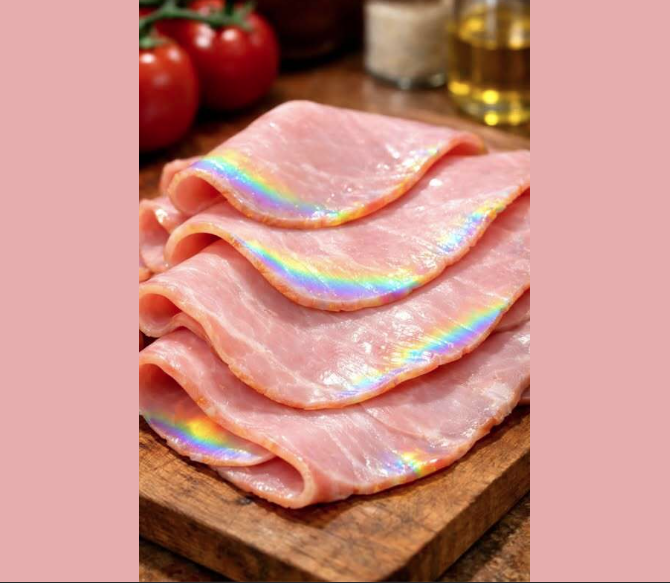
It’s a common experience in many kitchens, opening a fresh pack of deli ham and noticing unusual rainbow-like colors reflecting on the surface, which can look surprising and even concerning at first glance, often leading people to question whether the meat is still safe to eat.
Despite its unusual appearance, this colorful shine is usually not a sign of spoilage or contamination, but rather a natural optical effect known as iridescence, which occurs when light interacts with the surface structure of the meat.
Deli ham is made from muscle fibers that are tightly arranged, and when the meat is sliced very thin and smoothly, these microscopic structures are exposed in a way that allows light to reflect and scatter in multiple directions.
As light hits the surface, it separates into different wavelengths, creating shifting colors such as green, blue, or purple, depending on the angle of the light and how the surface is viewed.
This effect is similar to what happens on soap bubbles, oil on water, or even the surface of a compact disc, where light creates colorful patterns without any change to the material itself.
Moisture on the surface of the ham can enhance this effect, making the colors more visible, especially in freshly sliced or vacuum-sealed products where the surface remains smooth and hydrated.
Processed meats like ham, turkey, and roast beef are more likely to show this phenomenon because of their uniform texture and precise slicing, which allows light to behave in a more predictable way compared to rough or uneven surfaces.
The curing process, which involves salt, also contributes by helping the meat retain moisture, further supporting the reflective conditions that make iridescence more noticeable.
In the past, this rainbow effect often caused concern, as people associated unusual colors with spoilage, but food science has confirmed that iridescence alone does not indicate that the meat is unsafe.
However, it is still important to rely on proper indicators of spoilage, such as a sour or unusual smell, a slimy or sticky texture, or visible mold or discoloration that does not change when the light shifts.
Unlike iridescence, which changes depending on the viewing angle, signs of spoilage remain consistent and are caused by bacterial activity rather than light reflection.
Proper storage also plays a key role in maintaining freshness, as deli meats should be kept refrigerated, sealed tightly, and consumed within a few days after opening to reduce the risk of spoilage.
Even if the meat appears normal, time and exposure to air can affect its quality, making it important to follow recommended storage guidelines for safety.
The reason this rainbow effect is still common today is due to modern food processing techniques, which create smoother surfaces and preserve moisture more effectively, making the optical effect more visible than in the past.
Rather than being a defect, the colorful sheen is simply a result of how light interacts with the meat’s structure, showing that sometimes unusual appearances are caused by natural physical processes rather than anything harmful.
In the end, understanding this phenomenon helps reduce unnecessary concern and food waste, reminding us that not everything that looks unusual is a problem, and that recognizing the difference between visual effects and actual spoilage is key to making safe decisions.