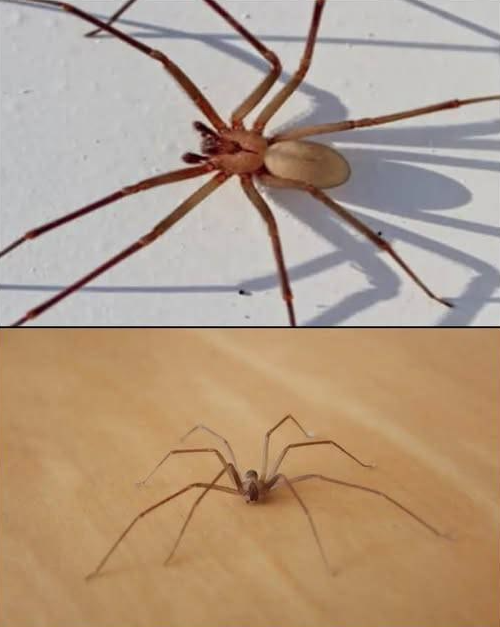
The brown recluse spider is one of the most talked-about spiders, often surrounded by fear and misunderstanding, yet in reality it is a shy and non-aggressive species that prefers to avoid humans and remain hidden in quiet environments.
This spider is typically light to medium brown in color and may have a darker marking on its back that is sometimes described as violin-shaped, although this marking can vary and is not always clearly visible in every individual.
Unlike most spiders, which have eight eyes, the brown recluse has six eyes arranged in pairs, a feature used by experts for identification, though it is difficult to observe without close inspection.
Its smooth body and uniform coloring allow it to blend easily into surroundings such as wood, cardboard, and dark corners, which is why it often goes unnoticed even when present indoors.
Behaviorally, the brown recluse is not aggressive and prefers to retreat rather than confront, spending most of its time hidden during the day and becoming active at night when it searches for food.
Encounters with humans are usually accidental and occur when the spider is disturbed, such as when reaching into storage areas, putting on clothing, or handling items that have not been used for a long time.
These spiders favor dry, dark, and undisturbed environments, and indoors they are often found in basements, attics, closets, garages, or behind furniture, while outdoors they may live under rocks, in woodpiles, or inside sheds.
They do not build large webs like other spiders, instead creating small, irregular webs mainly for shelter, which makes them even less noticeable in everyday environments.
Despite their reputation, brown recluse spiders play an important role in controlling insect populations, feeding on flies, mosquitoes, cockroaches, and other small pests, which helps maintain balance in their ecosystem.
They are also capable of surviving for long periods without food or water, allowing them to persist in environments where resources are limited, especially during colder seasons.
Bites from brown recluse spiders are uncommon and usually happen only when the spider feels trapped, and while reactions can vary, many bites are mild and heal without complications.
However, any unusual reaction such as increasing pain, spreading redness, or a wound that does not improve should be evaluated by a healthcare professional, as proper assessment is always the safest approach.
If a bite is suspected, basic steps include cleaning the area, applying a cool compress, avoiding irritation, and monitoring changes over time, while seeking medical advice if symptoms worsen.
Preventing encounters is often simple and involves keeping living spaces clean and organized, reducing clutter, sealing entry points, and checking stored items like clothing or boxes before use.
Understanding the true nature of the brown recluse helps reduce unnecessary fear, as most interactions are rare and avoidable, and the spider itself is more interested in staying hidden than interacting with people.
In the end, awareness and simple preventive habits are enough to stay safe, showing that knowledge is often the best way to replace fear with confidence and control.